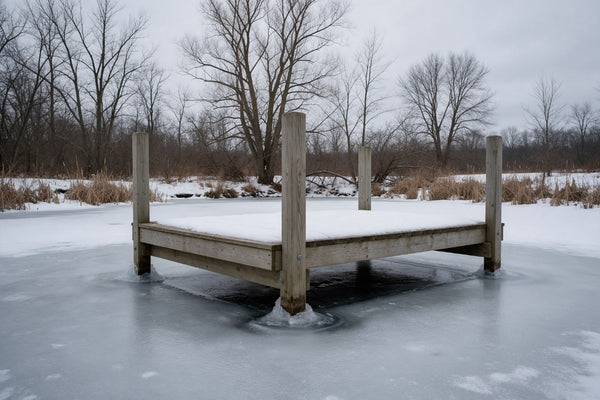
Quick answer: Whether you need one is mostly a question of where the pond is, and across the southern half of the country the honest answer is usually no.
Below is what actually kills fish under ice, which ponds are genuinely at risk, what the equipment does about it, and the part that matters most once one is running. If you would rather just talk it through, call or text us at (470) 354-1969.
Start with whether you need one at all
Winterkill is common in northern states and is almost never experienced in Oklahoma and the other southern states. Ohio State describes winter fish kills as somewhat uncommon even in Ohio. If your pond is in Georgia, Alabama, Texas or the Carolinas, that is most of your answer. Ice thick enough and long-lived enough to matter is a northern event.
Two things raise the risk where winter does bite. Ponds with a very dense aquatic plant community in summer are the most susceptible to winterkill during harsh winters. A one-acre pond six feet deep is less likely to winterkill than one three feet deep.
Fish slow their metabolism in winter, need less oxygen, and are generally fine; winterkill is the exception rather than the rule. One timely warm period of two to three days can greatly reduce the possibility of a fish kill. So the baseline case is a pond that gets through winter without help, and the question is whether yours is an exception.
What actually kills fish under ice
Winterkill is not caused by cold. It is caused by ice and snow shutting off the light, which is a different problem with a different answer. Cold water is actually better able to hold dissolved oxygen than warm water, and in ponds that do not freeze over, winter oxygen levels are typically higher than summer ones. That is worth reading twice, because it is the reverse of the intuition. The cold is not the threat.
Ice cover blocks oxygen moving from the air into the water, which leaves oxygen produced by algae and plants as the only source. As much as 70 to 90 percent of the dissolved oxygen in a pond comes from photosynthesis by plants and algae rather than from the surface. When sunlight is cut off, plants and algae stop producing oxygen and become net consumers of it through respiration.
Thin clear ice lets enough sunlight through for plants and algae to keep producing oxygen, and the trouble starts when the ice thickens or snow settles on top of it. Four inches of wet snow on top of the ice nearly eliminates sunlight penetration, and oxygen levels then decline quickly. Snow is the variable that matters, not the ice by itself.
In cold water, oxygen below 2 to 3 parts per million for an extended time will begin to kill fish, and 1 to 2 parts per million throughout the pond means a complete fish kill. Oklahoma State cautions that there is no hard and fast lethal lower limit for dissolved oxygen, because it varies by fish species and life stage. Trout are the most sensitive to low oxygen, bullheads and fathead minnows are the most tolerant, and bass and bluegill sit in between.
What a de-icer actually does about it
A de-icer is not a heater. It keeps a patch of water moving so it does not freeze; it does not warm the pond. Michigan State says an electric pond de-icer is fine as long as it floats near the top of the water and is powerful enough to keep the ice clear, and that colder states need a higher wattage unit.
Penn State credits aeration with adding oxygen directly through the bubbles and agitation, and with creating open areas that let oxygen diffuse in from the air. Ohio State describes a diffuser kept in shallow water as eroding a hole in the ice and allowing some exchange with the atmosphere. Note the wording in both: some exchange, and an area that is open. No source claims a hole on its own prevents winterkill.
Minnesota DNR takes its winter oxygen readings near the aerator, to see whether an oxygen refuge is being maintained. Surface aerators draw water from just below the surface and add oxygen to the upper layer, and while they do not break down stratification they can provide an oxygenated refuge. So the realistic goal is a pocket of livable water near the unit, not an oxygenated pond. That is what a state fisheries office measures, and it is what you should expect to buy.
The part that matters more than any of the above
Whatever you install, understand what it does to the ice before you install it, because that part is not reversible once someone walks out there. Ohio State Extension states that aeration during winter generally prevents safe ice from developing anywhere on the pond. Read that again. Not the open hole. Anywhere on the pond.
Michigan DNR tells people to watch for dock bubblers and de-icers because the ice near them will be unsafe. Iowa State Extension states plainly that winter aeration may be dangerous, because of the resulting hazardous opening in the ice and the management it requires in bad weather.
Michigan DNR states there is no reliable inch thickness that determines whether ice is safe. Minnesota DNR says there is no such thing as one hundred percent safe ice, and that you cannot judge its strength by appearance, age, thickness, temperature or snow cover. Michigan DNR says ice covered by snow should always be considered unsafe, because snow insulates the ice, slows freezing and can melt existing ice.
And if someone does go in, cold water works faster than the temperature suggests. When a person hits cold water, cold shock can cause a sudden gasp and rapid breathing that create a drowning risk on their own, even for confident swimmers in calm water. Cold water causes a loss of muscular control in the arms, legs, hands and feet within seconds, which makes self-rescue or staying afloat without help virtually impossible.
Wisconsin DNR warns pond and lake owners that they may be liable for any accidents caused by improperly marked ice holes, and that disputes between neighboring landowners may be handled through civil action. Which is why the run-time section below matters as much as the sizing does.
Run it less than you think
Penn State says an aeration system does not need to run continuously all winter, and should be switched on when ice forms and left off when the pond is ice free. That single instruction does two jobs: it cuts the power bill, and it cuts the number of days the ice is unsafe.
Wisconsin DNR recommends running an aerator or circulator used for pier protection on a timer, limited to the run time needed to keep the pier ice free. Ohio State notes that where open water is uncommon in winter, any open water may attract unusually high concentrations of waterfowl.
If the reason you are buying is a dock rather than the fish, there is a cheaper answer first. Wisconsin DNR says the best way to avoid ice damage to pilings and structures is to remove them from the water before ice up, and describes aerators as a tool to lengthen the structural life of permanent structures. Wisconsin DNR notes that installation, the size of the water body, ice force and other factors all influence how well ice-prevention equipment works.
Oxygen levels recover very quickly once a pond becomes ice free.
Not sure whether yours is at risk?
Tell us where the pond is, how deep it gets, how weedy it was in August, and whether anyone walks on it in winter. That last one changes the answer more than the first three.
Talk it through at (470) 354-1969Our Picks
These are surface units, which is what the guidance points at for winter. Each one holds an opening near itself rather than treating the whole pond.
Best overall

Starting at $1,029.00
Best for: Keeping ice off a dock, a boat lift or a seawall.
A dock-mounted unit that drives water upward to hold an opening around a pier or a mooring.
View current sizes, pricing & specs
Kasco Surface Pond Aerator & De-Icer
Starting at $1,323.00
Best for: A pond that wants surface agitation in summer and an opening in winter from the same unit.
A floating surface unit that both agitates the surface and holds an opening, so it earns its keep outside winter too.
View current sizes, pricing & specs
Scott Aerator Thermostat Controller
Starting at $109.95
Best for: Cutting run time, which is what the extension guidance and the Wisconsin marking rules both point at.
A temperature switch that runs the unit only when it is cold enough to need it.
View current sizes, pricing & specsFAQ
- Do I need a pond de-icer?
- Winterkill is common in northern states and is almost never experienced in Oklahoma and the other southern states. Fish slow their metabolism in winter, need less oxygen, and are generally fine; winterkill is the exception rather than the rule.
- What causes winterkill?
- Ice cover blocks oxygen moving from the air into the water, which leaves oxygen produced by algae and plants as the only source. Four inches of wet snow on top of the ice nearly eliminates sunlight penetration, and oxygen levels then decline quickly.
- Does cold water kill fish?
- Cold water is actually better able to hold dissolved oxygen than warm water, and in ponds that do not freeze over, winter oxygen levels are typically higher than summer ones. Winterkill is not caused by cold. It is caused by ice and snow shutting off the light, which is a different problem with a different answer.
- Does a de-icer heat the pond?
- A de-icer is not a heater. It keeps a patch of water moving so it does not freeze; it does not warm the pond. Michigan State says an electric pond de-icer is fine as long as it floats near the top of the water and is powerful enough to keep the ice clear, and that colder states need a higher wattage unit.
- How big does the opening need to be?
- Ohio State describes a diffuser kept in shallow water as eroding a hole in the ice and allowing some exchange with the atmosphere. Minnesota DNR takes its winter oxygen readings near the aerator, to see whether an oxygen refuge is being maintained. No source gives a hole-size figure for an earthen farm pond. The published percentages are for backyard and ornamental ponds and do not transfer.
- Is the ice safe if I run a de-icer?
- Ohio State Extension states that aeration during winter generally prevents safe ice from developing anywhere on the pond. Michigan DNR tells people to watch for dock bubblers and de-icers because the ice near them will be unsafe.
- How thick does ice need to be to walk on?
- Michigan DNR states there is no reliable inch thickness that determines whether ice is safe. Minnesota DNR publishes guidelines for new clear ice only, starting at four inches for activity on foot, and says ice can be two feet thick in one place and one inch thick a few yards away. Minnesota DNR says white ice, which is melted and refrozen snow, is only about half as strong as new clear ice, so the published thicknesses must be doubled for it.
- Should it run all winter?
- Penn State says an aeration system does not need to run continuously all winter, and should be switched on when ice forms and left off when the pond is ice free. Wisconsin DNR recommends running an aerator or circulator used for pier protection on a timer, limited to the run time needed to keep the pier ice free.
- What oxygen level is dangerous?
- In cold water, oxygen below 2 to 3 parts per million for an extended time will begin to kill fish, and 1 to 2 parts per million throughout the pond means a complete fish kill. Oklahoma State cautions that there is no hard and fast lethal lower limit for dissolved oxygen, because it varies by fish species and life stage.
Tell us where the pond is
Location, depth, how weedy it got last summer and who uses the ice. We will tell you whether this is a real risk for you, and we will say so plainly when the answer is that you do not need anything.
Call or text (470) 354-1969- Landon and Hunter, Pro Pond Supply
Sources: Penn State Extension, Winterkill in Ponds; Ohio State University Extension, Winter and Summer Fish Kills in Ponds (Fact Sheet A-8-01); Ohio State University School of Environment and Natural Resources, Ponds and Aquatic Life in the Winter; Ohio State University CFAES, Winter fish kills in ponds revisited; Oklahoma State University Extension, Fish Kills; Michigan State University Extension, Avoid winter kill in your pond; Michigan State University Extension, A look below the ice at fish behavior; NC State Extension, Pond Management Guide; Iowa State University Extension, Taking Care of Your Pond: Guide to Spring Management; Minnesota DNR, Winterkill and Other Fish Kills; Minnesota DNR, General ice thickness guidelines; Minnesota DNR, Ice safety; Michigan DNR, Ice Safety; Wisconsin DNR, Using Aerators and Aeration Systems; NOAA National Weather Service, Cold Water Hazards and Safety.